
2026 AI Outlook: Ten Strategic Signals That Will Define the Year Ahead
Adapted from the December 2025 issue of The Signal, the CAS Strategies newsletter.
The 2026 AI landscape will be shaped by forces that extend far beyond model performance. Organizations across every sector are grappling with agentic AI, expanding attack surfaces, regulatory divergence, vendor ecosystem complexity, and rising governance expectations. The policy and legal landscape is also shifting quickly, with new state, federal, and international requirements raising the stakes for how AI is deployed, audited, secured, and monitored. After working with Fortune 500s, nonprofits, startups, and government agencies throughout 2025, CAS Strategies identified the key trends that will determine AI readiness, risk, and business value in the year ahead.
Below are the Ten Strategic Signals for 2026: evidence-backed predictions that outline where leaders should invest, which risks deserve immediate attention, and which capabilities will define AI performance next year. Use this outlook to build a more resilient, trustworthy, and high-impact AI strategy.
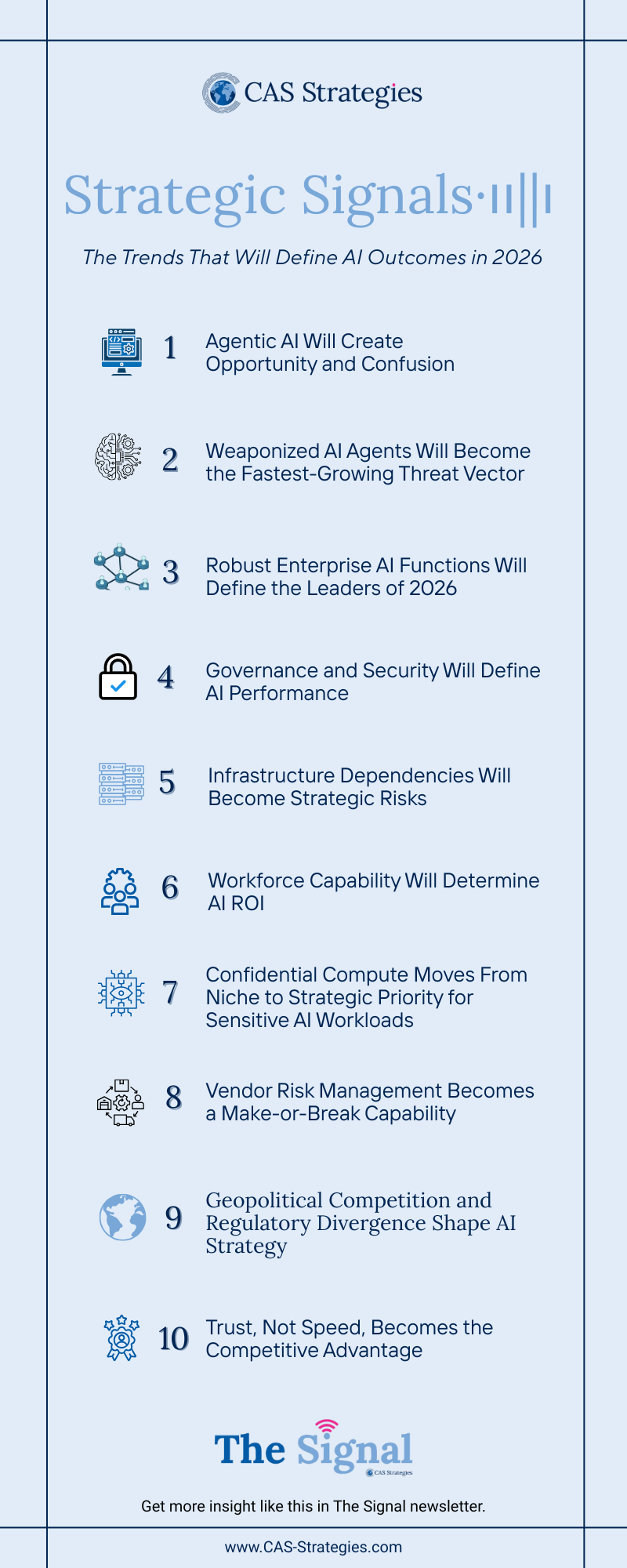
Strategic Signals for 2026
Ten forces shaping AI performance, risk, and business value next year. Use these signals to guide investment decisions, prioritize emerging risks, and build capabilities that scale with trust and resilience.
1. Agentic AI Will Create Opportunity and Confusion
Agentic AI is set to reshape workflows, commerce, and productivity, but maturity is still low. Most organizations won’t deploy agents at scale in 2026, but the companies that invest now in agent readiness (governance, data integrity, secure workflows, and workforce training) will gain a meaningful advantage when adoption accelerates.
Invest in: foundational governance, data quality, sandbox testing environments
Prioritize risk: misalignment, impersonation, unmonitored autonomy, unclear attribution
🔗 Read: The Age of Agentic Commerce: How AI Agents Will Reshape Power, Privacy, and Everyday Life
2. Weaponized AI Agents Will Become the Fastest-Growing Threat Vector
2025 made clear that adversaries are operationalizing AI, not as a tool, but as an attack surface. CrowdStrike researchers found that AI-generated code routinely introduces hidden vulnerabilities, including insecure logic paths, incomplete input validation, and dependency calls that evade standard code scanning (CrowdStrike Research).
At the same time, the Google Antigravity incident showed how attackers can exploit broken trust boundaries pivoting through AI pipelines, impersonating internal components, and manipulating high-privilege systems through multi-step chains that humans struggle to detect (Forbes Coverage).
Invest in: continuous red-teaming, behavioral monitoring, privilege decay, & secure SDLC for AI-generated code.
Prioritize risk: autonomous exploit chains, identity subversion, and AI-coded vulnerabilities entering production.
🔗Read: The Fragile Stack: What DeepSeek and Antigravity Reveal About AI’s Hidden Risks
🔗Read: The First AI Operator Has Entered The Chat
3. Robust Enterprise AI Functions Will Define the Leaders of 2026
The organizations that thrive in 2026 will be those that build real institutional capacity, not just pilot tools.
CAIO roles, AI PMOs, risk committees, and trust & safety units will shift from “nice-to-have” to essential operating infrastructure.
Invest in: staffing, cross-functional governance, model lifecycle processes
Prioritize risk: fragmented ownership, shadow AI development, unmanaged vendor exposure
🔗 Read: AI Deployment Playbook: Avoiding the Mistakes That Sink ROI and Customer Trust
4. Governance and Security Will Define AI Performance
Retrofitting controls doesn’t work. 2026 will reward organizations that build systems with auditability, provenance, lifecycle governance, and secure-by-design principles from the start.
Regulators, investors, and customers will expect it.
Invest in: provenance pipelines, secure development lifecycle (S-SDLC), evaluation frameworks
Prioritize risk: opaque outputs, untraceable agent actions, unverified data sources
🔗Read: Security Is Performance: Why AI Depends on Safety, Ethics, and Trust
🔗Read: Build Secure-by-Design Tech Before the AI Vulnerability Cataclysm Hits
5. Infrastructure Dependencies Will Become Strategic Risks
AI doesn’t run on ambition, it runs on chips, energy, compute, and minerals. Decisions involving the AI stack have become geopolitical calculations, as countries compete to host data centers and secure the resources that will power the next industrial revolution. In 2026, supply chain fragility and geopolitical constraints will shape AI roadmaps more than marketing cycles.
Invest in: infrastructure mapping, vendor diversification, long-term compute strategy
Prioritize risk: dependency on single vendors, mineral constraints, unstable supply chains
🔗 Read: The DR Congo’s Cobalt Power Move
6. Workforce Capability Will Determine AI ROI
Technology outpaced organizational learning in 2025. In 2026, companies that succeed will treat education, policy training, and digital fluency as core infrastructure.
The gap between organizations that train their people and those that don’t will widen dramatically.
Invest in: AI fluency training, governance education, ethical decision-making capacity
Prioritize risk: misuse, misinterpretation, overreliance on AI outputs, skill mismatches
🔗 Read: No Opportunity, No Trust: The Workforce AI Forgot
7. Confidential Compute Moves From Niche to Strategic Priority for Sensitive AI Workloads
As organizations increasingly push proprietary, regulated, and mission-critical data into AI systems, confidential compute will shift from a niche capability to a strategic requirement for securing sensitive inference and agent workflows. Encrypted memory, attested execution environments, and hardware-backed isolation will become essential for protecting data-in-use and managing trust boundaries across cloud and vendor ecosystems.
Invest in: confidential VMs, attestation pipelines, key management strategy, and secure inference architectures.
Prioritize risk: insider access, model extraction, data exposure during inference, and insecure agent-to-agent workflows.
🔗 Read: Unlocking the Future of Data Security: Confidential Computing as a Strategic Imperative
🔗 Read: How Confidential Computing lays the foundation for trusted AI
8. Vendor Risk Management Becomes a Make-or-Break Capability
AI adoption now runs through vendors—model APIs, agent frameworks, SaaS copilots, and cloud AI services. 2025 showed how vendor-originated vulnerabilities can cascade into customer environments, whether through AI-coded flaws shipped inside software, insecure default agent configurations, or unclear trust boundaries between components (as exposed in the Antigravity incident).
Invest in: AI-specific vendor assessments, provenance and auditability requirements, sandbox testing, and enforceable shared-responsibility models.
Prioritize risk: supply-chain compromise, opaque model behavior, insecure agent scaffolding, and unverified third-party controls.
🔗 Read: Choosing AI Tools Is Easy. Managing Them Well Is the Real Challenge.
9. Geopolitical Competition and Regulatory Divergence Shape AI Strategy
2025 showed that AI is now a geopolitical battleground. Nations are asserting AI sovereignty, tightening export controls, and advancing divergent regulatory regimes across the EU, U.S., China, Singapore, the UK, and the recent launch of the AI for Africa Initiative. In 2026, this fragmentation will create operational constraints around model access, compute availability, data flows, and compliance obligations.
Invest in: regulatory horizon scanning, diversified compute strategy, provenance documentation, and geopolitical risk mapping.
Prioritize risk: export control violations, supply-chain disruption, data localization limits, and misaligned regulatory requirements across markets.
🔗 Read: AI geopolitics and data centres in the age of technological rivalry
10. Trust, Not Speed, Becomes the Competitive Advantage
Markets are rewarding organizations that deploy AI with transparency and strong governance. Speed matters, but trusted speed matters more. In 2025, Microsoft boosted investor confidence through enhanced AI safety disclosures. Salesforce won enterprise deals in regulated sectors with its Responsible AI Framework and Einstein Trust Layer. Anthropic gained adoption by publishing clear safety evaluations of Claude 3. Adobe strengthened retention with its Content Credentials system, giving users provenance and traceability for AI-generated content.
Invest in: transparent reporting, trust frameworks, external validation
Prioritize risk: reputational fragility, regulatory missteps, alignment failures
🔗 Read: Companies that Prioritize AI Transparency Will Win Trust — and Customers
Signals only matter if they change how decisions get made. CAS Strategies helps organizations convert insight into action by aligning AI strategy, governance, and security with the realities of scale, regulation, and adversarial pressure. The result is AI that performs in practice, not just in pilots.
——————
This analysis was first shared with subscribers to The Signal, our bi-monthly briefing on AI, governance, and security. We’re publishing it here to support broader dialogue and informed decision-making as organizations plan for the year ahead.
To receive research-backed analysis like this before it’s released publicly, subscribe to The Signal, our bi-monthly briefing on the forces shaping AI, governance, and security. You’ll get actionable insights, practical tools, and early access to new frameworks that help leaders build systems that create value, strengthen trust, and stand up to disruption.
If your organization is preparing for agentic AI, expanding governance capabilities, or navigating AI risk, contact us to explore how CAS Strategies can help translate these signals into a roadmap for 2026 and beyond.
